Showing posts with label Antioch. Show all posts

Wednesday, October 22, 2014

Then and Now: Renaissance Court- Worcester Art Museum, 1979 and 2014

Renaissance Court- Worcester Art Museum, 1979 and 2014


Then and Now: 
Renaissance Court- Worcester Art Museum
1979 and 2014 
by Travis Simpkins


Renaissance Court- Worcester Art Museum, 1979

Renaissance Court- Worcester Art Museum, 2014


Wednesday, October 8, 2014

Then and Now: Renaissance Court- Worcester Art Museum, 1978 and 2014

Renaissance Court- Worcester Art Museum, 1978 and 2014


Then and Now: 
Renaissance Court- Worcester Art Museum
1978 and 2014 
by Travis Simpkins 


Renaissance Court- Worcester Art Museum, 1978

Renaissance Court- Worcester Art Museum, 2014

Saturday, October 4, 2014

Then and Now: Renaissance Court (Antioch Mosaic Installation)- Worcester Art Museum, 1937 and 2014

Renaissance Court (Antioch Mosaic)- Worcester Art Museum, 1937 and 2014


Then and Now: 
Renaissance Court (Antioch Mosaic)- 
Worcester Art Museum
1937 and 2014 
by Travis Simpkins


Renaissance Court (Antioch Mosaic)- Worcester Art Museum, 1937

Renaissance Court (Antioch Mosaic)- Worcester Art Museum, 2014

Saturday, July 12, 2014

Then and Now: Renaissance Court- Worcester Art Museum, 1982 and 2014

Renaissance Court- Worcester Art Museum, 1982 and 2014


Then and Now: 
Renaissance Court- Worcester Art Museum
1982 and 2014 
by Travis Simpkins


Renaissance Court- Worcester Art Museum, 1982

Renaissance Court- Worcester Art Museum, 2014

Wednesday, April 23, 2014

Then and Now: Renaissance Court- Worcester Art Museum, 1982 and 2014

Renaissance Court- Worcester Art Museum, 1982 and 2014


Then and Now: 
Renaissance Court- Worcester Art Museum
1982 and 2014 
by Travis Simpkins


Renaissance Court- Worcester Art Museum, 1982

Renaissance Court- Worcester Art Museum, 2014


Sunday, March 23, 2014

"The Arts of Antioch" by Lawrence Becker and Christine Kondoleon


     "This book features the first comprehensive interdisciplinary study of the mosaics from Antioch, one of the four capitals of the Roman and Early Christian world. A follow-up to the critically acclaimed Antioch: The Lost Ancient City by Christine Kondoleon, this volume includes the latest scholarly and scientific discoveries that grew out of the Antioch exhibition. For the first time, the research of art historians and archaeologists is combined with that of conservators and scientists to shed new light on mosaic and glass workshops. The authors take an in-depth look at the Antioch excavations, which yielded a range of mosaics, sculpture, and glass- and metalwork spanning four centuries. They also explore the development of mosaic conservation in museums since the 1930s. Included are recent findings on mosaic materials, artistic techniques, glassmaking technology, stone quarries, workshops, trade, and patronage. An introduction by the director of the Worcester Art Museum outlines the history of the museum's involvement with the excavations of Antioch, and gives insight into several personalities who were key to the realization of the project. The catalogue section offers detailed information regarding the archaeological context, art historical significance, and technical study of over 150 objects, including the finest group of Roman and Early Byzantine mosaics in North America, and a chronological series of 106 coins from Antioch. With 400 photographs and illustrations, The Arts of Antioch provides a new basis for future scientific and art historical study. The contributors to the book include Paula Artal-Isbrand (Worcester Art Museum), Anna Gonosová (University of California, Irvine), Florent Heintz (Antiquities Department, Sotheby's), Rebecca Molholt (Columbia University), Richard Newman (Museum of Fine Arts, Boston), Antero Tammisto (Institutum Historicum Universitatis Helsingiensis), Cornelius Vermeule III (Museum of Fine Arts, Boston), James A. Welu (Worcester Art Museum), Anne Leinster Windham (Assumption College), and Mark T. Wypyski (Metropolitan Museum of Art)." -amazon.com
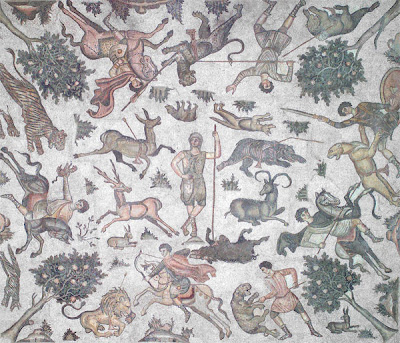
Worcester Hunt Mosaic

Antioch Excavations


The Drinking Contest

Purchase "The Arts of Antioch" HERE:

Wednesday, March 12, 2014

Then and Now: Renaissance Court- Worcester Art Museum, 1970 and 2014

Renaissance Court- Worcester Art Museum, 1970 and 2014


Then and Now: 
Renaissance Court- Worcester Art Museum
1970 and 2014 
by Travis Simpkins


Renaissance Court- Worcester Art Museum, 1970

Renaissance Court- Worcester Art Museum, 2014

Sunday, September 15, 2013

The Antioch Excavations (1932-1939)

Worcester Hunt Mosaic

     "Antioch was an ancient city located just outside the modern day city of Antakya, Turkey. During the reign of Hadrian, during the 2nd century, through to the reign of Justinian in the 6th century, mosaic floors were the fashion in the city and its surrounding suburbs. The city thrived until it was destroyed by earthquakes in 526 and 528. Beginning in 1932, a consortium of museums and institutions sponsored expeditions to the archaeological sites where the city of Antioch once stood. These museums, theWorcester Art Museum, Princeton University, the musĂ©e du Louvre, the Baltimore Museum of Art, and Harvard University's affiliate Dumbarton Oaks, were attempting to uncover great monuments, palaces, and treasures, but were disappointed when most of what was unearthed, under tons of silt, was just the remains of houses, most without any remaining walls. The only surviving part of the majority of the houses was the floors. The floors the archeologists discovered were covered in intricate mosaics. More than 300 mosaics were found. In 1939 the expedition ended and the archeologists packed up to leave. They left about half of the unearthed mosaics to the city if Antakya, the modern day city located at Antioch, which subsequently built a museum, the Antakya Archaeological Museum, to house them. The rest of the mosaics were split up amongst the institutions that took part in the dig, and were sent all over the world. To be transported, large amounts of concrete was poured behind the mosaics to create a stable backing. When dividing up the floors, the archeologists, often took apart rooms and sent different parts of the floor to different museums. For an exhibit at the Worcester Art Museum in 2000, mosaics were compiled from Paris, Baltimore, Princeton and Wellesley, to reassemble a single room's floor. After the expedition left, the pits were filled back in and olive groves were planted over them." -Wikipedia

Antioch Excavations

Installation of Worcester Hunt Mosaic at WAM, 1937.

Worcester Hunt Mosaic in Renaissance Court

Antioch Mosaics

The Drinking Contest