Showing posts with label Mosaic. Show all posts

Saturday, September 28, 2013

Worcester's Community Mosaic, 2000

Worcester's Community Mosaic, 2000

     In 2000, Travis Simpkins (and many others) worked in schools, youth centers and studios to assist artist Kim Emerson and instruct children in painting border tiles for "Worcester's Community Mosaic", on view in the Museum's Stoddard Garden Court.

Worcester's Community Mosaic, 2000

     "The Mosaic, created in 2000 with the help of more than 1,000 people and 14 community schools and agencies, was moved during the summer of 2005 from its Lancaster Street location to the Worcester Art Museum’s Stoddard Garden Court. In its new location, the Mosaic will provide inspiration to year-round Museum students, ambience to summer Café diners, and a backdrop for myriad community events. “The Community Mosaic has become a touchstone for the community—there are many stories about how making the mosaic had an unbelievable impact on people's lives,” said Honee A. Hess, the Museum’s director of education. Inspired by the Worcester Art Museum’s renowned collection of floor mosaics unearthed from the ancient city of Antioch, the 45-by-8-foot Worcester Community Mosaic reflects the themes of “Worcester” and “community.” Its design celebrates the city’s diversity, learning institutions, inventors, neighborhoods and culture, including representations of all four seasons, a triple decker, a rocket, books, and, of course, the heart of Massachusetts. To create the mural, the Worcester Art Museum commissioned California artist Kim Emerson to work in residence with two apprentices and enlisted the help of more than 1,000 community members ranging in age from 5 to 80. Children and adults at 14 community schools and organizations—including May Street, Elm Park and Clark Street schools; Quinsigamond Community College Women’s Center; YouthNet; Fallon Healthcare; AIDS Project Worcester; The Antioch Association of Worcester; Office of Elder Affairs; Black FBI; Centro Las Americas; Italian American Society; Big Brothers/Big Sisters of Worcester; and Arts Worcester—worked with Emerson on the 3-by-5-foot, 300-pound Mosaic panels." -www.worcesterart.org

Worcester's Community Mosaic- in it's original location, 2000

Sunday, September 15, 2013

The Antioch Excavations (1932-1939)

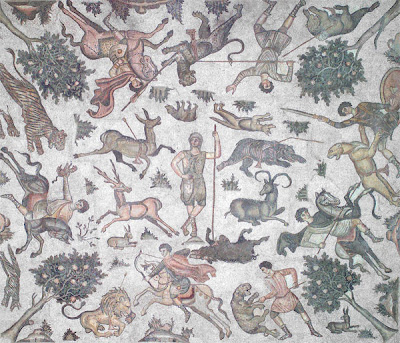
Worcester Hunt Mosaic

     "Antioch was an ancient city located just outside the modern day city of Antakya, Turkey. During the reign of Hadrian, during the 2nd century, through to the reign of Justinian in the 6th century, mosaic floors were the fashion in the city and its surrounding suburbs. The city thrived until it was destroyed by earthquakes in 526 and 528. Beginning in 1932, a consortium of museums and institutions sponsored expeditions to the archaeological sites where the city of Antioch once stood. These museums, theWorcester Art Museum, Princeton University, the musée du Louvre, the Baltimore Museum of Art, and Harvard University's affiliate Dumbarton Oaks, were attempting to uncover great monuments, palaces, and treasures, but were disappointed when most of what was unearthed, under tons of silt, was just the remains of houses, most without any remaining walls. The only surviving part of the majority of the houses was the floors. The floors the archeologists discovered were covered in intricate mosaics. More than 300 mosaics were found. In 1939 the expedition ended and the archeologists packed up to leave. They left about half of the unearthed mosaics to the city if Antakya, the modern day city located at Antioch, which subsequently built a museum, the Antakya Archaeological Museum, to house them. The rest of the mosaics were split up amongst the institutions that took part in the dig, and were sent all over the world. To be transported, large amounts of concrete was poured behind the mosaics to create a stable backing. When dividing up the floors, the archeologists, often took apart rooms and sent different parts of the floor to different museums. For an exhibit at the Worcester Art Museum in 2000, mosaics were compiled from Paris, Baltimore, Princeton and Wellesley, to reassemble a single room's floor. After the expedition left, the pits were filled back in and olive groves were planted over them." -Wikipedia

Antioch Excavations

Installation of Worcester Hunt Mosaic at WAM, 1937.

Worcester Hunt Mosaic in Renaissance Court

Antioch Mosaics

The Drinking Contest